
Education
Learners and trainees
Students and doctoral candidates
Teachers
University statictics
Scholarships
Career
Career orientation
Job market
Salary information and income survey
Academy
Mentoring
Community
Divisions
Local Sections
Regular's table
Chem_Connect
Equal opportunities, diversity
International activities and cooperations
Volunteers
Membership
Discover
Top topics
Nachrichten aus der Chemie
Angewandte Chemie
Chemistry Europe
ChemRxiv
Statements and position papers
Press releases
Brochures and scientific publications
Literature, videos and podcasts
Fascination with chemistry
Cartoons
Biographies of female chemists
Events
Conferences
Academy
Lectures
More events
Awards
Prizes
Historical sites of chemistry
About
Board and other bodies
Office
Statutes
Foundations
Press and public relations
Sustainability
Werner Hoffmann
Moderation: Petra Schultheiß-Reimann
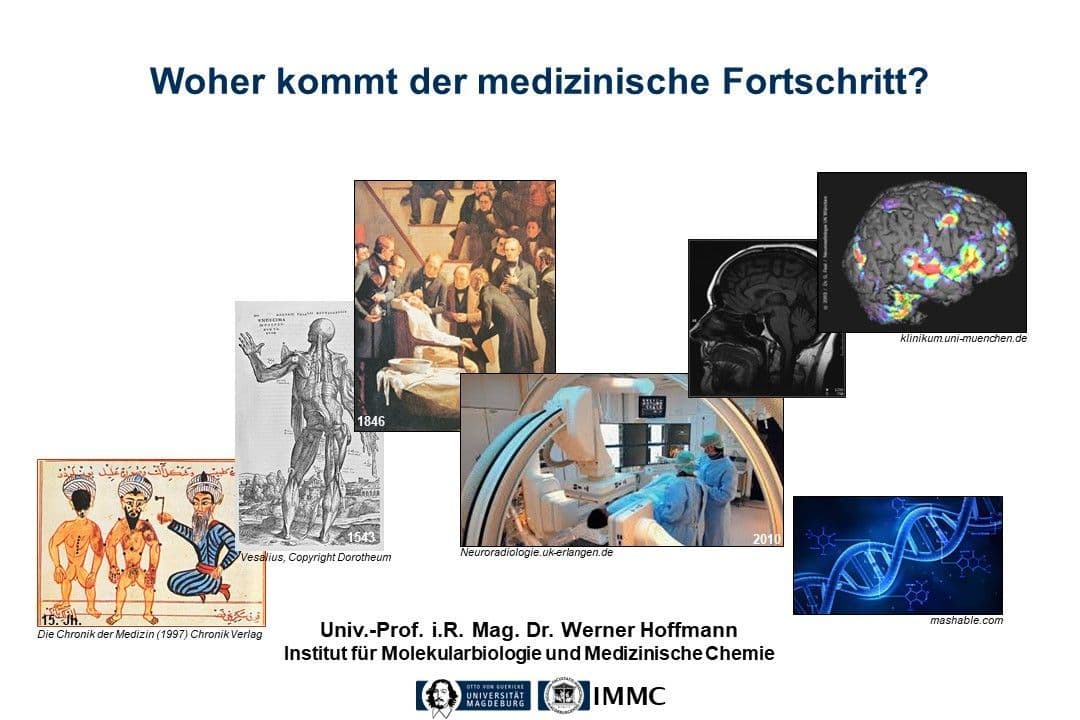
Until the end of the Middle Ages, medical practice in Europe was characterised by Hippocratic-Galenic medicine and Arab influences for over 1,300 years. With the beginning of the Renaissance, a sudden and diverse cultural development began in Europe. As a result, from around the middle of the 18th century, there was a gradual paradigm shift in medicine in Europe. From then on, life processes and diseases were explained in cellular and molecular terms. As a consequence of this new approach, enormous progress has been made in medicine diagnostics and therapy, particularly in the last 180 years - and this rapid development continues unabated.
The question therefore arises as to what has triggered this new dynamic and where the reasons for today's exponential progress in medicine lie. What expectations can we have for the future?