Education
Learners and trainees
Students and doctoral candidates
Teachers
University statictics
Scholarships
Career
Career orientation
Job market
Salary information and income survey
Academy
Mentoring
Community
Divisions
Local Sections
Regular's table
Chem_Connect
Equal opportunities, diversity
International activities and cooperations
Volunteers
Membership
Discover
Top topics
Nachrichten aus der Chemie
Angewandte Chemie
Chemistry Europe
ChemRxiv
Statements and position papers
Press releases
Brochures and scientific publications
Literature, videos and podcasts
Fascination with chemistry
Cartoons
Biographies of female chemists
Events
Conferences
Academy
Lectures
More events
Awards
Prizes
Historical sites of chemistry
About
Board and other bodies
Office
Statutes
Foundations
Press and public relations
Sustainability
Otto Machhammer
Moderation: Klaus-Peter Jäckel
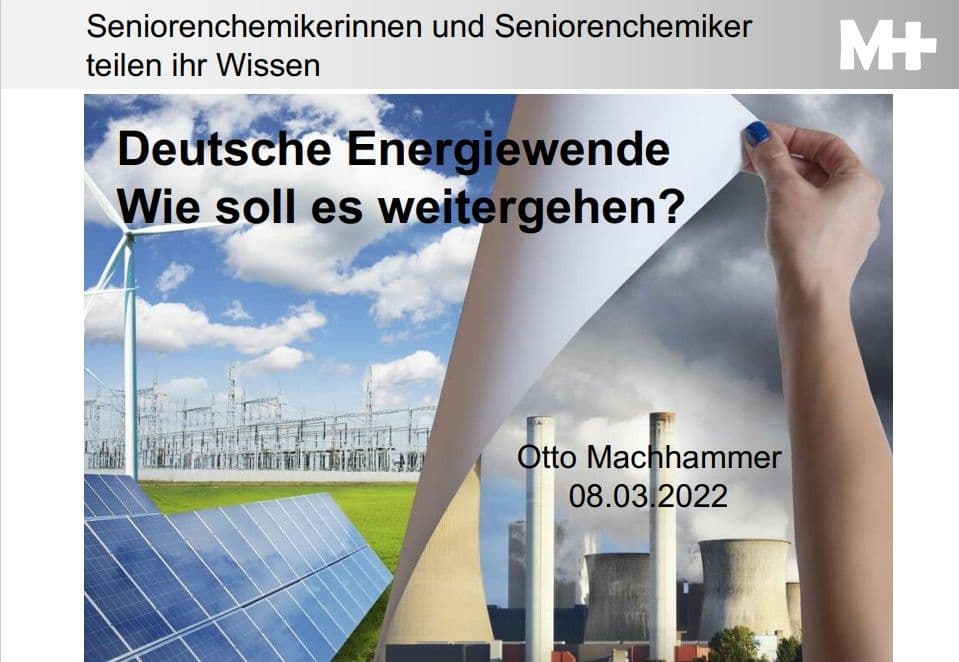
The energy transition will foreseeably require more renewable energy than can be produced in Germany. We should therefore start thinking at an early stage about where and in what form the shortfall could come from and which consumption sector should then receive which energy. Because there are consumers that absolutely need electricity, e.g. IT, industry or households. And there are consumers that need hydrogen in addition to electricity if they are to defossilise, e.g. the metallurgical or chemical industries. There is also the transport sector, which can be powered by both electricity and hydrogen as well as synthetic fuels.
The aim of the presentation is to provide techno-economic answers to the questions posed above. To this end, the efficiency of process chains based on renewable energies must be defined differently than for process chains based on limited resources. In addition, the low bid values at auctions for large-scale wind and photovoltaic plants must have nothing to do with the real LCOE.
The question of whether wind turbines or photovoltaic systems are more suitable for Power-to-X is also discussed in more detail. And where the meteorologically favoured areas for this are located, as well as which forms of energy are the most cost-effective for transport over long distances. Based on this, the author outlines an energy distribution scenario for Germany that makes sense from the author's point of view.