
Education
Learners and trainees
Students and doctoral candidates
Teachers
University statictics
Scholarships
Career
Career orientation
Job market
Salary information and income survey
Academy
Mentoring
Community
Divisions
Local Sections
Regular's table
Chem_Connect
Equal opportunities, diversity
International activities and cooperations
Volunteers
Membership
Discover
Top topics
Nachrichten aus der Chemie
Angewandte Chemie
Chemistry Europe
ChemRxiv
Statements and position papers
Press releases
Brochures and scientific publications
Literature, videos and podcasts
Fascination with chemistry
Cartoons
Biographies of female chemists
Events
Conferences
Academy
Lectures
More events
Awards
Prizes
Historical sites of chemistry
About
Board and other bodies
Office
Statutes
Foundations
Press and public relations
Sustainability
Bernhard Blümich
Moderation: Eva Wille
URL: https://us06web.zoom.us/j/85229055540?pwd=RdaNIN3AkEEprUROqHuu6IzQynug6i.1, meeting ID: 852 2905 5540, passcode 799549
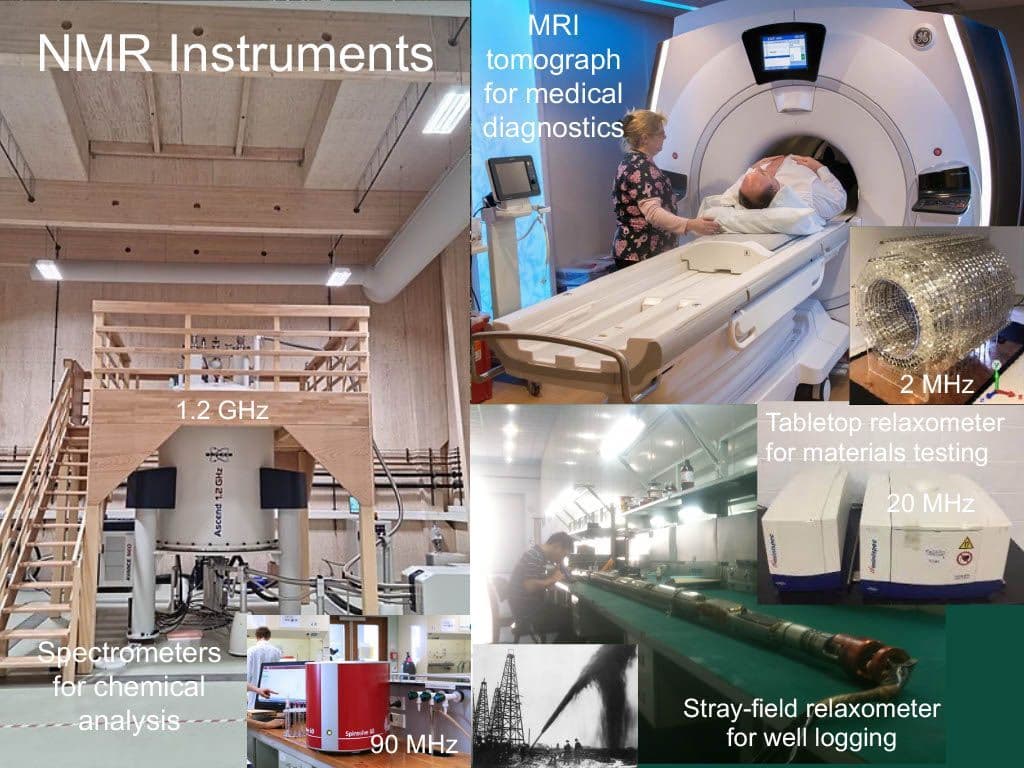
Nuclear magnetic resonance (NMR) is a physical resonance effect that is used to investigate the molecular properties of matter by irradiating atomic nuclei in magnetic fields with radio frequency waves. In chemistry, it is used to elucidate the structure and dynamics of molecules, in medicine to map the morphology and function of the human body, and in physics and engineering to characterise material properties. The increasing use of compact and mobile NMR devices expands the field of application of NMR [1,2] and motivates a reconsideration of its fundamentals [3]. Embedded in everyday experience, the lecture attempts to explain the seemingly complex nature of NMR with basic scientific knowledge. Various applications of compact NMR devices will be presented using examples from chemical analysis and material testing of cultural heritage artefacts.
References
1. B. Blümich, K. Singh, Desktop NMR and its Applications from Materials Science to Organic Chemistry, Angew. Chem. Int. ed. Engl. 57 (2018) 6996-7010.
2. B. Blümich, S. Haber-Pohlmeier, W. Zia, Compact NMR, de Gruyter, Berlin, 2014.
3. B. Blümich, Essential NMR, Springer, Cham, 2019.